Summary
Tesla, under the leadership of CEO Elon Musk, experienced a dramatic 71% decline in net income during the first quarter of 2025, reporting $409 million compared to $1.39 billion a year earlier, alongside a 9% drop in total revenue to $19.34 billion. This sharp downturn was largely attributed to aggressive electric vehicle (EV) price cuts, production disruptions linked to factory upgrades for a refreshed Model Y SUV, and broader market challenges that dampened sales and profit margins. Despite Tesla’s ongoing evolution toward AI and robotics, its core automotive business remains the primary revenue driver, making the recent financial setback particularly notable for investors and industry observers.
Musk’s multifaceted role—balancing Tesla’s strategic direction with various external commitments, including advisory positions in the U.S. government—has raised questions about his capacity to fully address the company’s immediate operational challenges. Analysts emphasize that Tesla’s ability to restore profitability hinges on effectively ramping up production, successfully launching new, more affordable EV models such as the anticipated “Model 2” or “Model Q,” and advancing autonomous driving technologies that underpin Tesla’s long-term vision. The company’s reliance on environmental regulatory credits to bolster margins further complicates its financial outlook, highlighting vulnerabilities if such incentives diminish.
In response to these challenges, Musk has announced strategic initiatives focusing on product diversification, cost optimization, and technological innovation. Planned launches of new vehicles—including a compact crossover codenamed “Redwood” and a next-generation Roadster—alongside enhanced Full Self-Driving capabilities and infrastructure investments, represent Tesla’s multifaceted approach to reviving growth and competitiveness in a rapidly evolving EV market. However, the temporary production disruptions caused by factory retooling and Musk’s divided attention have led to skepticism about the company’s near-term recovery prospects.
Market and expert reactions have been mixed, with concerns about Tesla’s profit margins lagging behind competitors like Volkswagen and doubts about the sustainability of its aggressive pricing strategy. Investors are closely watching upcoming earnings reports and Musk’s strategic moves to determine whether Tesla can stabilize its financial performance and maintain its leadership in electric vehicles amid intensifying competition and economic uncertainties.
Background
Tesla, led by CEO Elon Musk, has been a major player in the electric vehicle (EV) industry, with its automotive business driving the vast majority of its financial performance. Despite Musk’s claims that Tesla is evolving into an AI and robotics company, vehicle production and deliveries remain central to its revenue stream. However, Tesla faced a significant downturn in early 2025. In the first quarter of 2025, Tesla reported a steep 71% drop in net income to $409 million from $1.39 billion a year earlier, accompanied by a 9% decline in total revenue to $19.34 billion. Automotive revenue specifically fell 20% to $14 billion compared to the same period in 2024.
This downturn was attributed to several factors, including a protracted EV price-cutting strategy and unforeseen challenges that impacted the company’s bottom line. Additionally, Tesla experienced production disruptions caused by the changeover of Model Y assembly lines across its four factories, which led to lost production weeks in Q1 2025. The company was simultaneously ramping up production of a refreshed version of the Model Y SUV, necessitating factory updates that temporarily constrained output. Analysts had also lowered their expectations for vehicle deliveries, anticipating fewer than 372,410 units, reflecting Tesla’s first-ever annual sales decline in 2024.
Despite these setbacks, Tesla is pursuing plans to introduce a more affordable electric vehicle positioned below the Model 3, often referred to as the ‘Model 2’ or ‘Model Q.’ This lower-cost model is expected to launch in the first half of 2025, according to Tesla CFO Vaibhav Taneja. The company’s future growth also depends heavily on its investments in autonomous driving technology and overall production ramp-up, while external factors such as changing political sentiment could influence short-term demand for Tesla products.
Elon Musk’s attention has been notably divided, spending a significant amount of time engaged with U.S. government matters, which some analysts suggest may be a distraction from Tesla’s core business challenges. Market confidence in Tesla’s ability to revive its profit margins and growth will hinge on how effectively the company addresses these operational challenges and clarifies its autonomy plans.
Elon Musk’s Role at Tesla
Elon Musk, Tesla’s CEO and principal visionary, remains deeply involved in the company’s strategic direction despite balancing multiple high-profile commitments, including advisory roles in the U.S. government. During President Trump’s administration, Musk dedicated “a day or two per week” to Washington matters while continuing to lead Tesla’s efforts to innovate and expand. His leadership has been central to Tesla’s evolution from a niche electric car manufacturer into a global technology powerhouse focused not only on sustainable energy but also on advanced AI and robotics.
Under Musk’s stewardship, Tesla has made significant investments in autonomous vehicle technology and humanoid robotics, which Musk identified as critical for the company’s future growth. Although ambitious targets such as producing 10,000 Optimus robots in 2025 were set, Musk has acknowledged these goals may be overly optimistic and subject to adjustment. Despite these forward-looking projects, Tesla’s core automotive business continues to drive the majority of its revenue, and recent quarterly performance—marked by a 71% plunge in Q1 2025 profits—has raised concerns among analysts and investors.
Musk’s dual focus between government advisory duties and Tesla’s executive demands has prompted speculation about his capacity to fully address the company’s short-term challenges. Some analysts argue that if Musk were to reduce his external commitments and concentrate solely on Tesla, the company could avoid permanent brand damage and better pursue its long-term vision. Nevertheless, Musk has indicated that while he may scale back his government involvement as Tesla’s financial pressures mount, he does not intend to cease engagement with other projects such as the Dogecoin cryptocurrency.
In-Depth Analysis of Q1 2025 Profit Decline
Tesla experienced a significant decline in profits during the first quarter of 2025, with net income falling by 71% to $409 million compared to $1.39 billion a year earlier. This sharp drop was attributed primarily to a prolonged electric vehicle (EV) price-cutting strategy and a range of unforeseen challenges that adversely impacted the company’s bottom line. The company’s total revenue also saw a decline, dropping 9% year-over-year to $19.34 billion, falling short of analyst expectations which had projected approximately $21.11 billion.
Automotive revenue was particularly affected, decreasing 20% from $17.4 billion to $14 billion year-over-year. Tesla cited production line updates at its four vehicle factories, aimed at preparing for a refreshed Model Y SUV, as a contributing factor to the reduced output and revenue in this segment. Vehicle deliveries also underperformed, with estimates pointing to a 3.7% decrease to 372,410 units, although analysts had anticipated even weaker delivery numbers due to Tesla’s first-ever annual sales decline in 2024. Despite these delivery figures being an important metric, Tesla cautioned that vehicle deliveries and storage deployments alone are insufficient indicators of quarterly financial results, which also depend on factors such as average selling price, cost of sales, and foreign exchange movements.
The decline in profit margins was a notable concern, especially when compared to competitors like Volkswagen, underscoring Tesla’s “likely cash burn” situation in the near term. Analysts are closely watching Tesla’s gross margin and earnings per share (EPS) to gauge recovery potential, with Wall Street consensus estimating a Q1 EPS of $0.41 per share, slightly higher than Estimize’s crowdsourced prediction of $0.40. However, Tesla’s reported adjusted earnings per share were 27 cents, below the estimated 39 cents, indicating a performance shortfall relative to market expectations.
Tesla’s management acknowledged the need for “prudent investments” in both vehicle and energy businesses to position the company for future growth, while recognizing that the rate of this growth in 2025 will be influenced by factors such as the acceleration of autonomous driving technology, production ramp-up at factories, and the broader macroeconomic environment. Additionally, changing political sentiments, particularly linked to Elon Musk’s public profile, have been flagged as potential risks that could meaningfully impact short-term demand for Tesla products.
Strategic Initiatives Announced by Elon Musk to Restore Profitability
In response to Tesla’s financial downturn in the first quarter of 2025, CEO Elon Musk has outlined several strategic initiatives aimed at restoring the company’s profitability and sustaining its leadership in the electric vehicle (EV) market. These initiatives reflect a multifaceted approach focusing on product innovation, cost management, and technological advancements.
A key component of Musk’s strategy involves accelerating the launch of new vehicle models to capture broader market segments. Tesla plans to introduce several new affordable models by early 2025, including a mass-market electric vehicle codenamed “Redwood,” described as a compact crossover expected to enter production by the end of 2025. Additionally, the next-generation Roadster sports car is targeted for late 2025 production, alongside multiple new electric station wagons and lower-cost versions of existing models such as the Model 3 and Model Y, achieved by reducing features and optimizing hardware. This shift reflects a deliberate pivot from solely producing premium EVs toward a more diverse lineup to enhance market penetration and volume sales.
To complement the product lineup expansion, Tesla continues to invest heavily in advanced automotive technologies. The company rolled out FSD (Full Self-Driving) Supervised 12.5 in the third quarter of 2024, which includes improvements like Actually Smart Summon and enhanced highway driving features that bolster vehicle safety and convenience. Such technological innovations are integral to Tesla’s long-term vision of transitioning from an automaker to an AI-driven mobility provider, especially with the upcoming deployment of Robotaxi services slated to begin in Austin by June 2025, expanding to other cities by year-end.
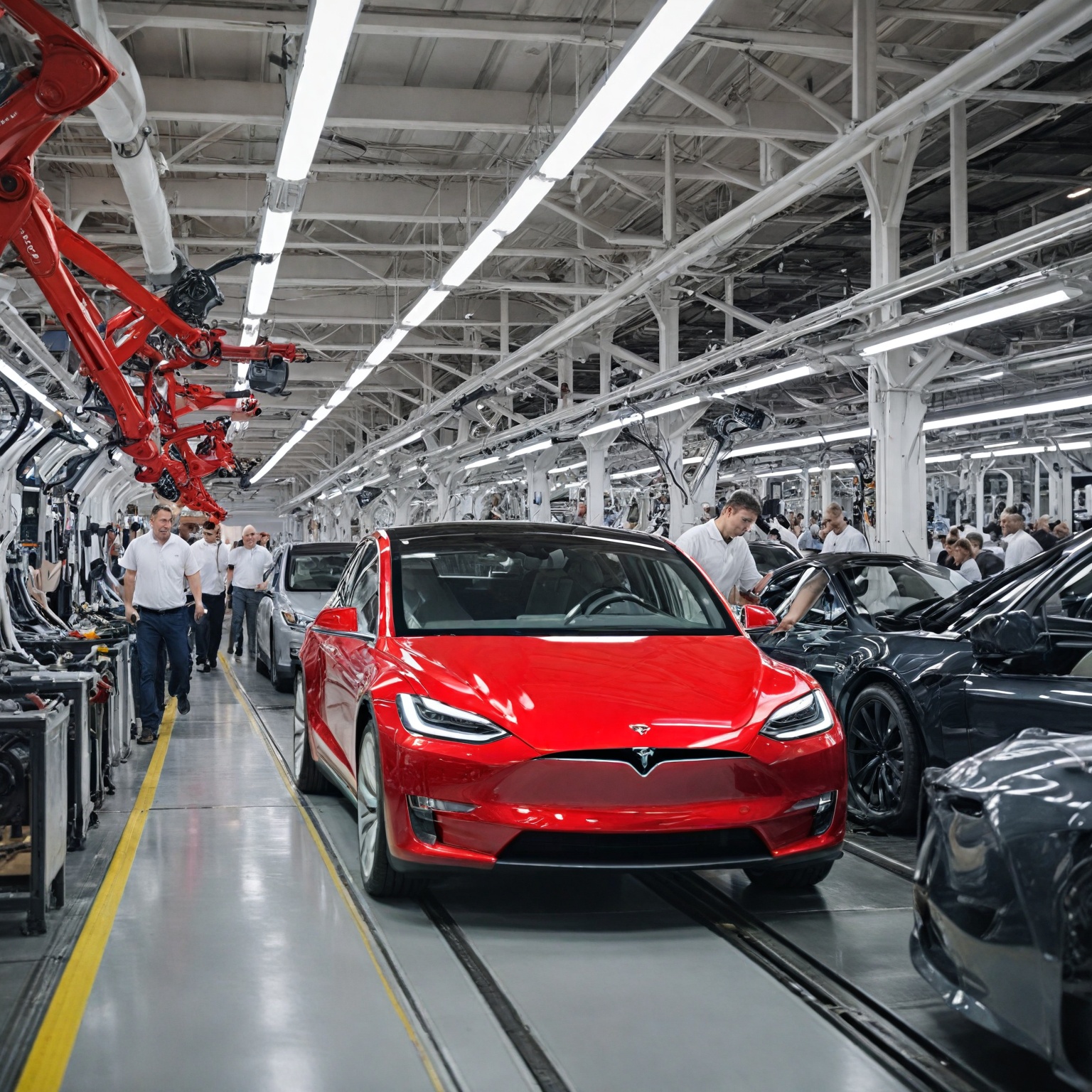
Operationally, Tesla is managing factory upgrades and production line changes to facilitate the refreshed Model Y SUV, which features redesigned elements such as a quieter cabin, expansive storage, and advanced safety systems. Although these upgrades temporarily disrupted production and contributed to the Q1 revenue decline, Musk has expressed confidence in the ongoing ramp-up of the new Model Y across all four vehicle factories. Infrastructure development, including the construction of the Semi factory scheduled to commence production by late 2025, further underscores Tesla’s commitment to scaling manufacturing capabilities and improving operational efficiencies.
Musk also announced plans to reduce his direct involvement in government efficiency initiatives beginning May 2025, likely to focus more intensively on Tesla’s core business recovery and innovation efforts. The company is also working on developing comprehensive testing infrastructure, including open- and closed-loop evaluation tools and hardware-in-the-loop systems, to accelerate innovation cycles and maintain product quality.
Financial Performance Metrics and Indicators for Recovery Evaluation
Tesla’s financial performance in Q1 2025 exhibited significant challenges, marked by a 9% year-over-year decline in total revenue to $19.3 billion and a more pronounced 20% drop in automotive revenue to $14 billion. The company’s operating income plunged 66% from $1.17 billion in the previous year to $400 million, resulting in a slim operating margin of 2.1%. This contraction was partly attributed to increased expenses associated with artificial intelligence initiatives and the temporary halting of automotive sales profitability absent environmental regulatory credits, which themselves rose to $595 million from $432 million a year earlier.
Earnings per share (EPS) also fell short of expectations, with adjusted EPS reported at 27 cents versus the estimated 39 cents, reflecting the underlying operational pressures Tesla faced during this period. Analyst consensus anticipated revenues around $21.34 billion and earnings of $0.41 per share for the quarter; however, Tesla underperformed these forecasts amid lower-than-expected vehicle deliveries and production line updates to introduce a refreshed Model Y SUV across its four factories.
From a broader perspective, Tesla’s historical financial structure reveals that years of heavy investments in manufacturing capacity and production efficiency had previously delayed profitability, leading to a critical reliance on retained earnings to sustain operations. Core financial ratios such as Price-to-Earnings (P/E), Return on Investment (ROI), and dividend yields provide benchmarks against industry averages for evaluating Tesla’s recovery prospects but are currently impacted by the company’s narrowed margins and cash flow concerns.
Going forward, Tesla’s ability to stabilize and improve its profit margins will be closely watched by investors and analysts, who emphasize the importance of clear communication regarding autonomy plans and strategic focus amid CEO Elon Musk’s varied commitments. The company’s forthcoming earnings calls and shareholder updates are expected to provide further insight into whether these financial indicators can reverse their downward trends and signal a sustainable recovery.
Market and Expert Reactions to Tesla’s Profit Decline and Recovery Plans
Tesla’s reported profit plunge in Q1 2025 has drawn significant market and expert scrutiny. Analysts attribute the sharp decline primarily to the company’s extended electric vehicle (EV) price-cutting strategy combined with “several unforeseen challenges” that negatively impacted Tesla’s bottom line. The disappointing profit margins have raised concerns, especially given that Tesla’s margins are now notably worse than competitors like Volkswagen, fueling skepticism about the company’s financial resilience and operational strategy.
Market expectations were further tempered by Tesla’s announcement of vehicle deliveries falling approximately 50,000 units short of Q1 2024 figures, intensifying doubts about demand and Tesla’s ability to meet its revenue targets. This shortfall has prompted analysts to revise downward their revenue and earnings forecasts, signaling a cautious outlook for Tesla’s near-term financial performance. The company’s upcoming Q1 2025 earnings call, scheduled for April 22, 2025, is highly anticipated as investors and analysts look for clarity on how Tesla plans to address these challenges.
Despite the criticism, Tesla’s leadership remains optimistic about a turnaround, with management forecasting a return to growth in the vehicle business by 2025. However, market confidence appears contingent on Tesla’s ability to justify its current profit margins, effectively communicate its autonomy and AI ambitions, and manage CEO Elon Musk’s public focus away from political distractions. Analysts also emphasize the importance of Tesla’s capital structure, highlighting the role of retained earnings in supporting ongoing investments in manufacturing and production efficiency—a factor that has historically delayed sustained profitability but is critical for long-term growth.
Potential Challenges and Risks to Profit Recovery
Tesla faces several significant challenges and risks that could impede the recovery of its profits following a 71% plunge in Q1 2025. One of the primary factors contributing to the recent profit decline is the company’s ongoing strategy of aggressive price cuts for electric vehicles (EVs), which, while aimed at boosting sales volume, has severely compressed profit margins. The company reported a 66% decrease in operating income to $400 million, resulting in a slim 2.1% operating margin. These figures indicate Tesla’s current vulnerability in maintaining profitability through discounted pricing.
In addition to pricing pressures, Tesla is experiencing increased expenses tied to investments in artificial intelligence and autonomy projects, which add to operational costs and impact near-term profitability. While these investments are intended to secure long-term growth, they contribute to the financial strain Tesla faces in the short term. The company has also cautioned that changing political sentiment and macroeconomic uncertainties could affect consumer demand, further complicating profit recovery efforts.
Another critical challenge relates to Tesla’s plans to launch more affordable EV models. Although the company announced intentions to begin production of lower-cost vehicles in the first half of 2025, reports suggest these plans may face delays of several months. Producing cheaper EVs profitably remains difficult due to high battery costs and the complexities involved in manufacturing quality vehicles at lower price points. Tesla’s detailed study of competitor models, such as the Honda Civic, underscores the technical and cost challenges involved in this segment.
Moreover, Tesla’s reliance on revenue from environmental regulatory credits to offset automotive losses highlights an underlying fragility in its current business model. In Q1 2024, credit revenue increased to $595 million, which was
Future Outlook
Tesla’s prospects for 2025 hinge on several key developments and strategic investments that aim to restore growth following a significant profit plunge in Q1 2025. The company is anticipating the launch of new vehicle models, including a restyled Model Y and potentially the unveiling of the Model Q, which could invigorate consumer interest and sales. Additionally, Tesla’s growth strategy appears to focus heavily on the future introduction of the CyberCab robotaxi, which is expected to play a pivotal role in the company’s long-term profitability.
Despite these optimistic product plans, Tesla faces challenges related to macroeconomic conditions, production ramp-up, and customer demand fluctuations, partly influenced by changing political sentiments and CEO Elon Musk’s public engagements. The company itself has indicated that the rate of growth will depend on the acceleration of its autonomy efforts, factory production increases, and broader economic factors, with guidance subject to revision after the Q2 update.
Financial analysts project Tesla’s revenue to remain relatively flat in 2025, around $21.41 billion, which is a decline from the $25.7 billion reported in Q4 2024, signaling a cautious market outlook. The company’s ability to improve profit margins, which currently lag behind competitors such as Volkswagen, will be critical to reversing the recent downturn. Tesla’s focus on building scalable evaluation tools and leveraging data from its fleet to advance autonomous driving technologies reflects its commitment to innovation as a pathway to future profitability.